
A buyer requests a barcode update after the supplier has started packing retail products. Sending a new print file fixes future production, but it does not settle what should happen to cartons already packed with the approved version. Before issuing an amendment, the buyer needs to confirm whether the original barcode remains valid for the destination and acceptable to the customer.
Consider an illustrative 1,000-piece order: 300 units are packed with sleeve A, 700 units are not yet packed, and 400 unused A sleeves remain in stock. Version B is the requested revision. The quantities and prices in this example are hypothetical, not records of a HolaSourcing customer order.
Key Takeaways
- Check the approval scope: Product samples and printed artwork may require separate approvals.
- Confirm actual quantities: Freeze the packed and unpacked counts before changing the purchase order.
- Compare the full rework cost: Include replacement packaging, labor, inspection and possible delays.
- Keep every team aligned: The supplier, inspector and warehouse must work from the same approved revision.
Confirm What the Approved Sample Actually Covers
Find the purchase-order (PO) line and SKU before drafting a change. In this example, the product itself remains as approved. Only the barcode and sleeve artwork need review; the material, dimensions and other accepted specifications should remain unchanged unless both parties expressly amend them.
Product approval and printed-artwork approval are not automatically the same event. Compare the accepted sample, dated artwork attachment and supplier correspondence. If the printer used a file that the buyer approved, the cost discussion may differ from a situation in which the supplier printed the wrong file. The order terms and the documented sequence matter.
For private-label orders, link each approved artwork revision to the relevant PO line. HolaSourcing describes packaging, labels and sample coordination in its OEM & Private Label Sourcing service.
Review the entire A and B files, not only the barcode box. Check SKU, surrounding copy, size, position and version identifiers. A filename such as “final_new_2” is less useful than a specific, dated revision that both parties can identify.
Freeze the Quantity at an Agreed Cut-Off
Ask the factory to confirm a count at a named time. As more products are packed, quantities change; an amendment based on yesterday’s count could give the supplier, inspector and warehouse different instructions. If a temporary packing pause is needed, confirm the scheduling and cost consequences.
| Inventory / work status | Illustrative count | Decision needed |
|---|---|---|
| Packed with version A | 300 units | Keep A only if valid and accepted; otherwise rework or hold |
| Unpacked products | 700 units | Apply approved version B after proof acceptance |
| Unused A sleeves (packaging stock) | 400 sleeves | Agree who owns, stores, returns or disposes of the old stock |

The 400 loose sleeves are packaging inventory, not another 400 product units. The order still contains 1,000 products: 300 packed and 700 awaiting packing. Confirm separately how many new B sleeves the supplier must print, allowing for any agreed waste or spare quantity.
If A is incorrect under applicable barcode, marketplace or destination requirements, do not treat it as a valid alternative simply because it was once approved. The buyer should confirm the required correction with the appropriate party before releasing any affected batch.
Compare the Cost of Keeping A Versus Reworking It
Worked Example: Reprinting Versus Full Rework
Only if both A and B are valid for the destination and accepted by the customer does a split-version option make sense. On that assumption, imagine a quote of $120 to provide B sleeves for the 700 unpacked units, compared with $260 to supply B sleeves for the full 1,000 units and rework the 300 already packed. These are illustrative prices, not a supplier quotation.
The difference is $140 under those assumptions, but a cost comparison cannot stop there. Ask whether rework includes opening cartons, removing A sleeves, repacking, inspection and disposal of unused packaging. Storage, new artwork proofs and schedule changes may also affect the total.
If the correction delays dispatch, check any warehouse and freight consequences against the actual booking. HolaSourcing outlines its consolidation and freight coordination through the Shipping Solution page. The buyer should approve the trade-off before the agent or supplier releases goods.
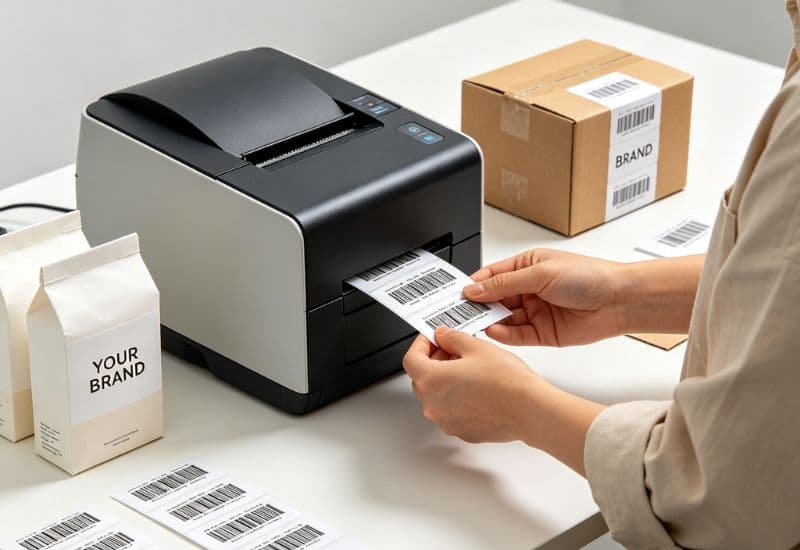
For unused A sleeves, agree ownership and disposal or storage charges in writing. Reusing them on another order is reasonable only when that order’s product identifier, barcode and approved artwork are compatible.
Record the Amendment So Every Team Uses the Same Version
An amended PO, a change order or another agreed written instruction should make the decision actionable. In particular, state the exact version and quantities rather than saying “use the latest artwork.”
- PO identification: PO number, line, SKU and the product specification that remains unchanged.
- Artwork revisions: Artwork A and B file identifiers, approval dates and the exact barcode revision.
- Quantity records: Cut-off count, affected carton or batch marks, and the quantity assigned to each version.
- Unused packaging: Disposition of unused A sleeves, including ownership and any handling charge.
- Commercial approval: Agreed price adjustment, revised completion date, required proof and buyer approval authority.
If the factory later counts 310 packed units rather than 300, reconcile the extra ten before releasing the amendment. The supplier should confirm the revised count in writing. The active inspection brief and warehouse receiving list then need the same numbers.
Tie Proof Approval to a Realistic Schedule
A Friday dispatch target may depend on B being approved by Tuesday. Record that dependency rather than treating Friday as unconditional. If the proof is delayed, request an updated production and shipping schedule.
Choose proof for the actual risk. Digital artwork can confirm intended barcode data. A printed proof can reveal problems with placement, legibility and fit. If the selling channel requires reliable scanning, verify the barcode on finished packaging.
Update Inspection and Warehouse Release Instructions
The inspection brief should carry the final decision. Where an approved A/B split is allowed, give the inspector both version identifiers, clear carton marks and accepted quantities. If full rework is required, remove any outdated split instruction before inspection begins.
At receiving, unidentified cartons should be held until their SKU, version and quantity can be matched to the amended PO and supplier confirmation. Goods that have arrived are not automatically cleared for shipment.
HolaSourcing can coordinate supplier communication and production follow-up under its Product Sourcing service; inspection scope should be agreed separately through its quality control arrangements. The buyer should also decide in advance who has authority to accept commercial changes.
For a change-order review, send the PO reference, both artwork files, affected quantities and requested delivery date through the HolaSourcing contact page. Ask which coordination, inspection and warehouse services are included in the proposed scope.
Conclusion
A purchase-order change is complete only when the supplier, inspector and receiving team can identify the same approved artwork, quantity and shipment status. Keep the commercial decision and the physical goods aligned before anything leaves the warehouse.
FAQs
Can I ship the original barcode version with the corrected one?
Only if both versions meet relevant requirements and the buyer or customer accepts the split. Otherwise the affected goods need correction or a documented hold.
Does every barcode change need a physical proof?
Not necessarily. Digital checks can confirm data and artwork, while printed samples or scan verification may be appropriate for placement, legibility and performance.
Who pays for the unused sleeves?
The answer depends on the approved file, the purchase agreement and who requested or caused the change. Agree ownership and any rework or storage charges before proceeding.
Can a sourcing agent approve a price adjustment?
Only if the buyer has delegated that authority. Otherwise the agent can gather costs, coordinate suppliers and present options for the buyer to decide.